The rules are actually easy:
Don’t make any mistakes.
But since it is (unfortunately) rare to do so without mistakes, here are some things about the rules of the trial. At this point we would like to mention only the factors that lead to an overall result.
The score
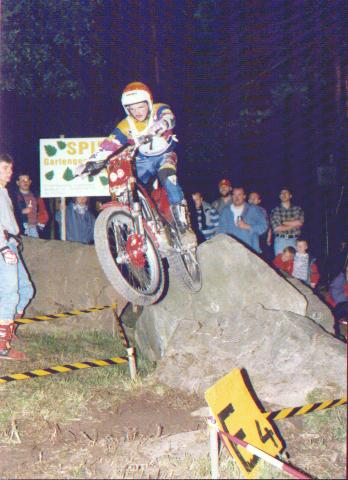
The competition consists of several sections. In each of the 3 rounds each section must be driven exactly once. The driver’s mistakes will be recorded as points. At the end the driver who has collected the least number of error points in all 3 rounds wins.
Judges will watch every movement of the driver and the machine very carefully. They must not miss the fastest “dab” (the light touching of a foot on the ground). In order to provide qualified judges who are able to cope with the situation, our judges are instructed and trained in the sections before each event.
Beginning and end of the section are marked with A and E signs, only between these signs a scoring will be done. Faultless means overcoming all difficulties while riding, i.e. not stopping, pushing or even falling, but also without assistance from the feet. These are all mistakes, which are noted to the rider on a carried points card with different scoring.
Before the start of the event, a maximum driving time is set, in which all sections and laps are to be driven. Before the start of the section, the rider parks his bike, walks the section, chooses a lane that seems suitable to him (there is usually more than one possible route through a section) and observes his competitors as they pass through in order to avoid possible mistakes. So that nobody takes too much time, there is the already mentioned maximum driving time.
Only the most serious mistake in a section is evaluated, so the driver cannot get more than 5 penalty points per section, unless he refuses the passage. A rider can get more penalty points if he exceeds the section time of 90 seconds. The correct level of difficulty of a section is considered to be reached when at least two or three riders complete it with zero faults.
| Mistakes | Penalty Points |
|---|---|
| 1x foot on the ground | 1 |
| 2x foot on the ground | 2 |
| more than 2x feet on the ground | 3 |
| Dismount Fall Leaving the limits |
5 |
The Drivers
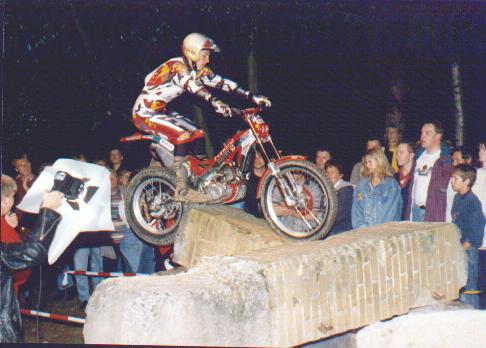
The trial rider must have an enormous amount of machine control, so he usually drives slowly, manoeuvres front and rear wheel with centimetre precision, skilfully lifts the front wheel up to a step with a gas push, jumps over obstacles, always striving to complete the section without mistakes.
A certain amount of training is essential for the rider, which not only includes riding the bike; endurance, speed and concentration also require constant practice. Even if the movements are hardly visible to the spectators, the efforts can only be guessed at — only through enormously power-sapping body control is the rider able to guide himself and his machine as one unit safely through the sections.
The Machines
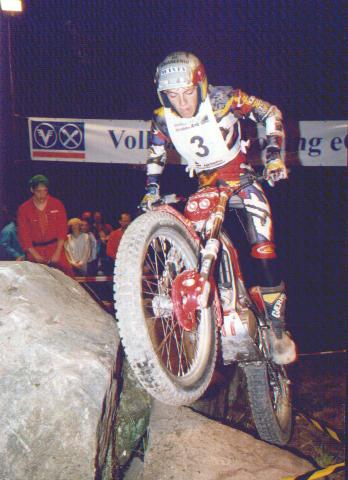
Trial bikes are anything but ordinary, they are sports equipment of a special kind. This is obvious at first glance and becomes clear at the latest when you first encounter these high performance machines in real life. They have a weight between 66 – 69 kg. Available are e.g. 80ccm, 125ccm, 250ccm, and 300ccm models of the brand manufacturers Sherco, GASGAS, Montesa, Beta, Scorpa, Ossa, JTG(JOTA GAS). These are the bikes of the sport. The classic 2-stroke models are popular, but are more and more attacked by current 4-stroke models. The main features are the incredible explosive power, the low centre of gravity and the good traction of the tyres, whereby the air pressure plays a decisive role.